
Top of Products > Solder-Aid > HIKARU'S DIARY ON LEARNING TO SOLDER > EPISODE 9: "Flow and Reflow"



Good morning.
Good morning, Hikaru. Are you getting used to the company?
Yes, I think I am.
I'm so glad to hear that.
By the way, let's talk about various soldering methods today.
Soldering methods called "Reflow" and "Flow" that you mentioned before?
Yes. You have a good memory.
The number of electronic components used for P.W.B.s in electric products is very large.
If these components are soldered one at a time, it takes a lot of time and the soldering cost is staggeringly high. Furthermore, labor of soldering workers who handle so many components is very large.
These seems somewhat interesting.
Making a single product may be interesting, but in the case of mass production, you can't say that.
Yes, you're right.
Today, I'll explain how to solder a large quantity of electronic components simultaneously.
It seems TV shopping or something like that.
Hey, watch your words.
I'm sorry.
You say one word too many.
Soldering methods are generally classified into three types: "Iron soldering", "Dip soldering" and "Reflow soldering". You know about "Iron soldering", don't you?
Yes, of course.
The "Dip soldering method" is the method of dipping a target part into melted solder. The target part is directly heated with melted solder. It can be illustrated like this:
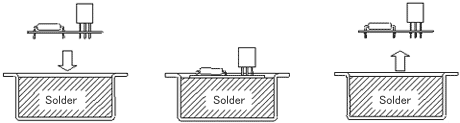
Indeed, this method can simultaneously solder all parts.
The container that stores melted solder is called the "solder pot" or "solder bath".
Our product, HAKKO FX-305, HAKKO FX-301B, corresponds to this. But, HAKKO FX-301B is generally used for pre-tinning of relatively small P.W.B.s and wiring.
For dip soldering, it is important to control the temperature of solder in the bath, and the concentration of impurities in the soldering bath. Otherwise, metal in the patterns and target parts will melt into the soldering bath.
The temperature of solder in the bath is set about 30 to 80℃ higher than the melting point of solder.
I see.
But, this method causes oxidization of the solder surface, resulting in a soldering failure.
Oxidization?
Yes. In particular, tin in the solder will combine with oxygen in the air.
To prevent oxidization, we must frequently remove the oxide film on the solder surface.
The flow solder bath was devised so that the solder surface remains free from the oxide film. Flow soldering is the most popular method.
The principle of the flow solder bath can be illlustrated like this.
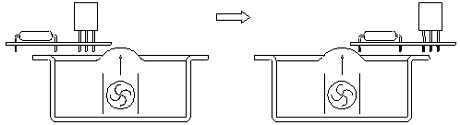
Since the solder is stirred with a pump, a new solder surface constantly appears.
That's right. Our product, HAKKO 485, corresponds to this.
But, since the solder bath always has a new solder surface, it will be oxidized one after another. Consequently, the amount of resultant oxide increases.
I see. This method is useful. But, with this method the surface mounting components will drop into the solder bath, I guess.
Yes. The components are fixed with adhesive before soldering. But, to solder surface mounting components, the reflow soldering method is generally used.
Reflow and "Flow". These are somewhat confusing terms.
What are you talking about?
Reflow soldering is the method of applying solder to a pattern with any method.
I cannot imagine the method to do it?
You ask a question about everything. Stop asking questions until I explain it to you!
For example, one method is preliminary solder plating, or placing the solder that has been formed into a shape suitable for the purpose of use, such as disk, washer and global shape onto flux. Another method is solder paste printing, or pasting a mixture of flux and solder powder onto a pattern.
Generally, the solder paste printing method is used.
After applying solder onto a pattern, put a target component onto it. Then, the solder is melted with a certain heat source to solder the component.
This method is classified into infrared reflow soldering, laser reflow soldering and so on, depending on the type of heat source.
It can be illustrated like this:
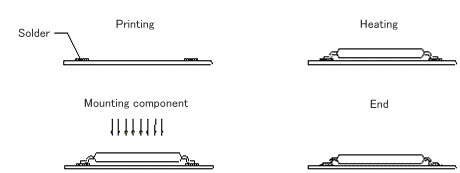
It looks like a pizza.

Ha-ha-ha-ha-ha (Laughing) It looks like a pizza, as you say.
But, soldering irons seem to be unnecessary now, because such convenient methods are available.
No, that's not always true.