
Top of Products > Solder-Aid > HIKARU'S DIARY ON LEARNING TO SOLDER > EPISODE 3 : "Essential Points"



Now, let's start soldering. First, I'll connect the plug into an outlet.
No Hikaru. Make sure everything is prepared before connecting the plug into the outlet.
What should I prepare?
First, ensure proper ventilation.
Why? Does this room smell?
No, it doesn't. This solder contains resin-based flux, which is chemical that makes it easy to solder on the metal surface. The principal ingredient of the flux is pine resin (rosin), so it is called "resin flux cored solder".
| R type | Does not contain any activator. The R type flux is used for soldering that requires high reliability, because it contains no chemical substance that causes corrosion. |
|---|---|
| RMA type | To increase solderability of the flux, a small quantity of activator is added. Among the three types described here, the RMA type flux is ranked at an intermediate position, in terms of reliability and solderability. |
| RA type | The RA type flux contains a larger quantity of activator than the RMA type. The RA type is used for soldering that requires excellent solderability. |
I know pine resin is applied to the sole of boxing ring shoes to prevent slippage.
Right! I'm surprised you said that. Well, if such pine resin-containing flux is used for soldering, it evaporates and emits smoke. If you inhale the smoke in a large quantity for a long period, you may feel sick. Therefore, you should provide a well-ventilated condition.
Is that right? I feel safe with you.
In addition, it is very dangerous to place an inflammable object near the soldering iron because the soldering tip becomes very hot. Before you start soldering, you should put inflammable objects away.
Absolutely. Is there anything else important that I should know?
This is not a preparation, but when you stop soldering temporarily or leave the room, you must disconnect the plug from the outlet. Although the soldering iron a tool that anyone can use, it can cause a burn or fire unless it is handled with care. You must pay enough attention to ensure safety.

I see. Are there any other preparations that I should make?
The cleaning sponge supplied with the iron holder should be moistened with water in advance. If you use the sponge when it is dry, the sponge will be burned. Now, we don't want to forget the most important point.
What's that?
Read through the instruction manual. It is very important.
Example of instruction in DASH Instruction Manual
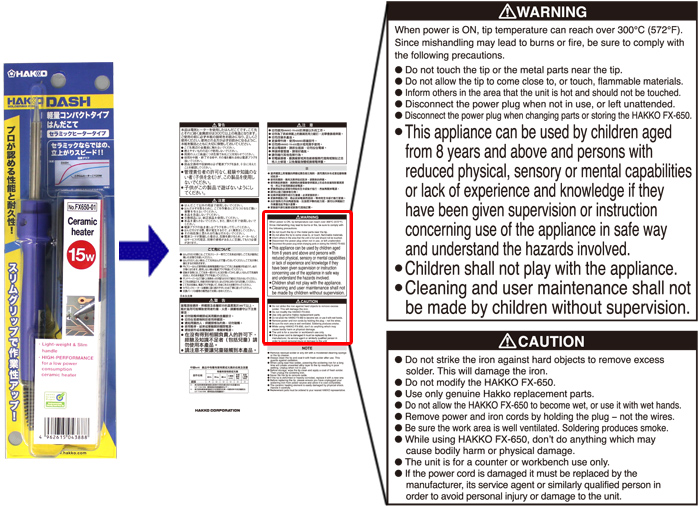
* Click on image to see larger image.